Thursday, 31 October 2013

The journey towards a book: Part2


The journey towards a book: Part 2

Now having all the key pieces I had to begin to edit down the almost 300 photos of the artwork into a more concise and fluid number. Along with this came the writing of the narrative itself and the sorting of both the poetry and the journal pages. It was a very intense next 6 months of development.

Early on I realized that this was another art piece unto itself. So I approached it this way. Complex in finding a rhythm, in finding a flow that would hopefully draw the reader to want to uncover the story just as much as looking at the paintings and drawings.

I continued to edit and narrow down choices and realized, once again, that this was in some ways harder than creating a painting. With a painting, if someone didn’t follow at all my thoughts or concepts that went into the piece they could at least enjoy the surfaces, the light, the movement itself that makes up a painting. But in laying out this project I was laying out my deepest thoughts, exposing how I process the work, how I think about paintings in a very specific way: the philosophy that is the structure onto which I lay the paint.

In other words: I was exposing myself with nothing to hide behind.


Tuesday, 29 October 2013

The journey towards a book: Part 1


The journey towards a book: Part 1

Last year I began to put together the elements for a book about my work and life that had been in the back of my mind for over ten years. During that time I had repeatedly been asked by some of my collectors if I would ever be more forthwith with my process.

So I began by assembling 8x10 photographs of my artwork by decades without editing. This became an ever-expanding binder that then incorporated my poems that correlated with specific pieces. Once that was laid out I began to figure out the narrative, the threads that linger throughout my studio experience and quickly saw that if this was to be truthful and rich it had to have excerpts from my journals.

The other key was space: The building of my three studios over these 40 years. So I began to collect photos all the way back to 1977 and inserting them into the pages. The binder grew, once again.


Wednesday, 23 October 2013

October 23, 2013

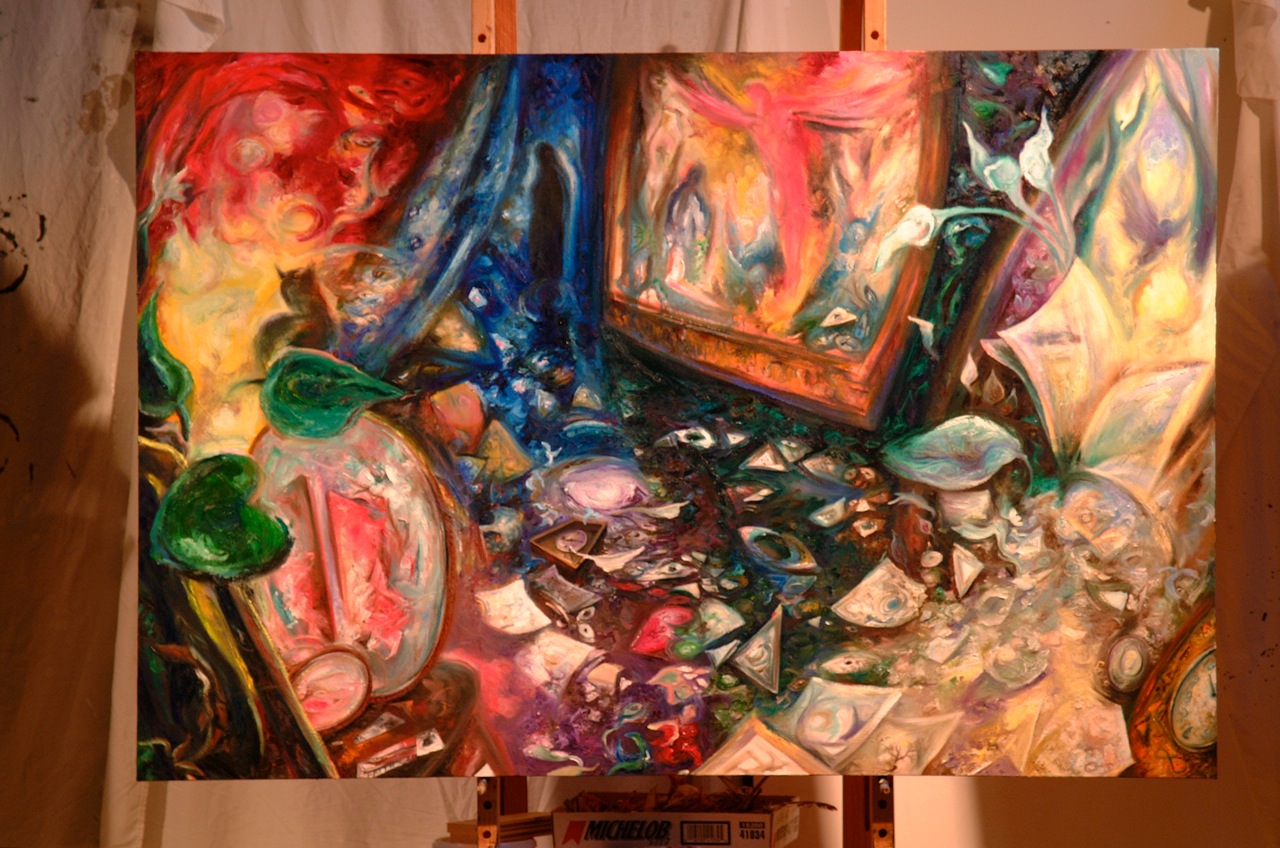
I am back in the studio in Chicago after an intense 5 months painting and working on a book about the past 40 years of my life as an artist. As I am now posting directly to this blog I wanted to first thank Rebecca Astrop for the wonderful writing she did this past year. I also would be remiss if I didn't post the finished painting from the series she wrote about my working on the painting in Montana.

The title is: "Reflections Glimmer in Unwavering Need" 59"x 83 1/2", oil on canvas 2013


Monday, 24 June 2013

Progress and Process in Montana: Part Six


Wallace has begun work on glazing. It's at this point in his process that the artist's focus falls upon "pushing into the space, highlighting and obscuring, charging the emotion of the painting."


Sunday, 16 June 2013

Progress and Process in Montana: Part Five


At this point in the process, Wallace is spending long days, and even longer nights working with the painting.

Says the artist, "I continue to uncover the dialogue within this piece. Every surface has been touched. Still, there's much more to build before I start to think about the push and pull of space, of emotion and the dramatic sense of light and shadow."

Monday, 10 June 2013

Progress and Process in Montana: Part Four

In the original entry in this series, we touched on Wallace's unusual use of gesso in the early stages of preparing his canvasses. Gesso is blend of white paint mixed with chalk, and in most cases is used as a primer, adding a thick, even layer to the canvas before the process of painting itself begins.

In his work with the highly textured materials of his sculptural surrounds, Wallace found himself inspired to consider the canvas's surface in a similar way. He began experimenting with the use of gesso to inscribe contoured images directly onto the canvas. "I started to depart from the traditional way of priming a canvas, and instead began to think of the primer, the gesso, as a means to impart movement, texture and imagery that would be buried underneath the paint.”

“I found this to be a very meditative process, and it's one which has become a part of my understanding of the painting even before it has begun. The texture is barely visible when the painting is complete. In this way, I am fetishising the work in the historical sense of the word: the laying down of this scribed image, scratched into the primer, with the knowledge that the paint will obscure it. The marks become like ghost images laying underneath the painting, underpinning its entire creation."

Tuesday, 4 June 2013

Progress and Process in Montana: Part Three

Welcome to the third installment in this focus series, which takes a closer look at Wallace's creative process this summer at his studio in Montana.

Over the last week or so, Wallace has been focused on blocking the composition of his current canvas. "At this stage, my days are very much enveloped in the rhythm and flow of both the physical objects and the colors within the work, and with how these elements guide the eye through the piece."


These canvasses can take several months to complete, and at this moment, Wallace explains, "there are many weeks to go before I can really begin to think about glazing and playing with the push and pull of space with light and shadow, of what is obscured, and what is revealed, pushed into view."


“The symbolism within the painting is a dialogue that emerges with each stroke of the brush. As I paint, layers are unveiled. Each discovery leads to another and another. Some things that end up on the canvas are conscious and others are a result of simply allowing myself to paint and to let the dialogue emerge. It is a dance that sometimes feels very fragile, and other times is so rich as to be joyous.”

Return next week to watch as the work continues to unfold and take form. Meanwhile if you have a specific question about Wallace's process, or about the work, we'd love to hear from you - please leave a comment below.